How to Batch Create a Week of Content in 90 Minutes During Nap Time (The SAHM Content Creator’s Complete Workflow)
Published February 17, 2026 | Margin Minutes: Systems and Workflows
It is 12:47pm. The baby just went down. The toddler is miraculously quiet. You have approximately 73 minutes before someone wakes up crying or yelling your name from another room.
You could scroll. You could eat something in peace. You could stare at the wall and enjoy the silence like the rare, beautiful gift that it is.
Or you could batch create a full week of content and never think about posting again until next Monday.
That last option is exactly what we are going to talk about today.
If you have ever sat down to create content only to spend 45 minutes deciding what to post, another 20 minutes writing a caption, and then given up entirely because the baby woke up before you finished — this post is for you. The problem is not your motivation. The problem is not your niche, your ideas, or your consistency. The problem is that you do not have a system.
Batch content creation for moms is not a luxury. It is a survival strategy. And once you build this workflow into your week, daily posting pressure becomes something that used to happen to you. This is the exact content batching workflow I use to create seven days of social media content in a single focused session, without losing my mind, sacrificing my family time, or posting anything that feels rushed or off-brand.
Let us get into it.
Content batching is exactly what it sounds like. Instead of creating content every single day, you sit down once and create everything in one focused session. Planning, filming, designing, writing captions, and scheduling all happen in one block of time instead of being spread across seven separate, interrupted, chaotic days.
Here is why this matters so much specifically for stay-at-home moms building faceless content brands.
Your time is not your own. Not really. You get pockets of it, stolen moments between naps and meals and tantrums and the general beautiful chaos of raising small humans. If your content creation strategy requires you to show up and create something from scratch every single day, it is going to fall apart the moment life gets heavy, which it will, because life always does.
Batch creating content protects you from that cycle. You create when you have capacity and you show up consistently even on the days you have none. It separates the creative work from the showing up work. And for a stay-at-home mom building in the margins, that separation is everything.
A sustainable content creation system for moms is not about doing more. It is about being intentional with the time you actually have so that every minute inside that nap time window actually moves your brand forward.
Before we get into the 90-minute breakdown, there are a few things you need to have in place. Consider this your pre-batch setup. It only needs to happen once, and it makes every future batch session run faster and smoother.
Your content pillars. If you do not know what these are yet, head to the blog post on the content pillar framework first and come back. You need to have three to five repeating themes that organize everything you create. Without pillars, batch creating content is just staring at a blank screen for longer.
A content idea bank. A simple running list of ideas, stored somewhere you can access quickly, whether that is a folder in your phone notes, a Notion database, or a basic Google doc. Before every batch session you will pull from this list so you are never starting from zero.
Your tools ready to go. For faceless content creation, this typically means Canva open on your laptop for carousels and graphics, CapCut downloaded on your phone for Reels and TikToks, and a scheduling tool like Later or the native platform scheduler ready to go. No setup during the batch session. Everything should already be open before you sit down.
A loose plan for the week. You do not need a detailed content calendar at this stage, just a general sense of what pillars you are covering that week and roughly how many posts you want to create. For most SAHM content creators, five to seven posts across platforms is a realistic and sustainable week.
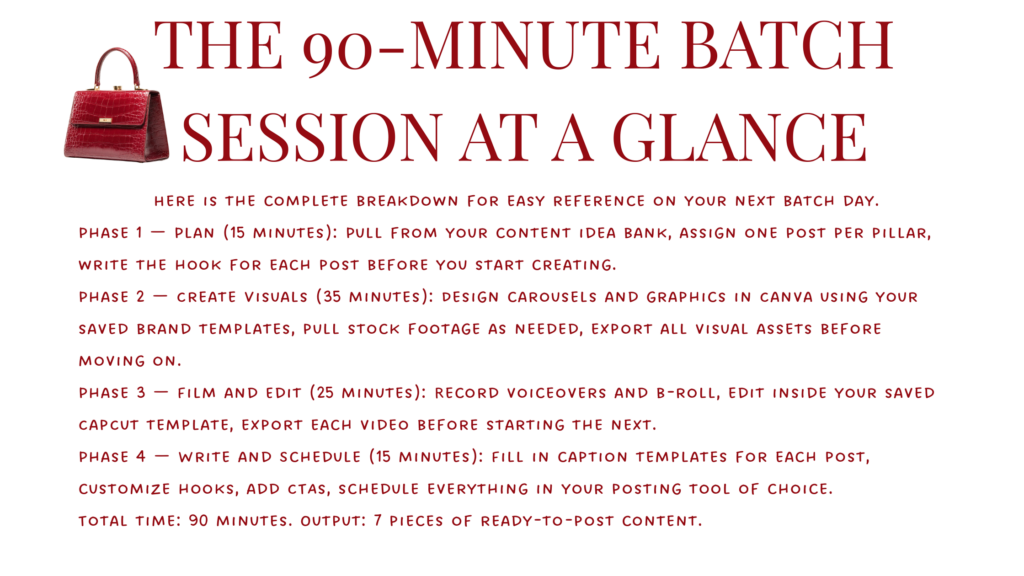
This is the actual nap time content creation system. It is broken into four phases. Each phase has a specific time block. Protect those time blocks aggressively.
This is the most important 15 minutes of your entire batch session, and it is the phase most people skip because it feels like procrastinating. It is not procrastinating. It is the difference between a session that produces seven pieces of usable content and a session that produces two half-finished ideas and a lot of frustration.
Open your content idea bank and your weekly pillar rotation. Decide exactly what you are creating in this session. Not vaguely. Specifically.
Write down each post with the following: what pillar it falls under, what type of content it is (carousel, Reel, text post, voiceover video), and what the main point or hook is in one sentence. That last part is critical. If you cannot write the hook in one sentence, the idea is not clear enough yet. Clarify it before you move into creation mode.
For a seven-post week, your plan might look something like this.
Monday: Educational carousel on content pillars, five slides, hook is “You will never wonder what to post again after reading this.” Tuesday: Voiceover Reel over stock footage, hook is “Here is what my Monday batch day actually looks like.” Wednesday: Permission slip text post, hook is “You are allowed to want more and still love your life exactly as it is.” Thursday: Tutorial screen recording, hook is “The CapCut template method that cut my editing time in half.” Friday: Behind-the-scenes story series, three to five frames, no formal hook needed. Saturday: Truth bomb short video, hook is “Your first 100 followers matter more than your first 10,000. Here is why.” Sunday: Scripture encouragement graphic, Proverbs 31:25, brand aesthetic graphic only.
That is seven posts, mapped out in 15 minutes, before you have created a single thing. Now execution is just following a checklist.
Now you build everything visual. Carousels in Canva. Graphics. Any text-based posts. This phase is purely visual creation, no writing captions, no filming, just designing.
Open Canva with your brand templates already set up. If you do not have templates yet, stop and create them before your next batch session. Templates are the single biggest time-saver in any faceless content creation workflow because you are never designing from scratch. You are just updating text and swapping out colors or images within a framework you already built.
Work through your visual posts one by one. Do not switch back and forth between posts mid-design. Finish one completely before moving to the next. Switching between tasks mid-creation costs you mental energy and time you cannot afford inside a nap time window.
For your carousel, build all slides in one pass. For your graphics, use the template and update the text. For any posts using stock footage, pull your clips from Pexels, Pixabay, or whatever stock footage site is part of your faceless content creation toolkit, and drop them into your project. Do not browse for footage during this phase. Pull what you need and move forward.
By the time this phase ends you should have all of your visual assets designed, downloaded, or staged for editing.
This phase covers any content that requires your phone. Voiceover Reels, screen recordings, short TikToks, behind-the-scenes captures. This is also where CapCut does the heavy lifting.
Before you film anything, open CapCut and access your saved templates. A content creation template in CapCut is a pre-built sequence that includes your fonts, timing, transitions, and audio style. Once you have a template built, every video you create inside it just requires swapping out the clips and updating the text. Your editing time goes from 45 minutes per video down to roughly 8 to 10 minutes per video.
For voiceover content, record your audio first in a quiet space, then layer your stock footage underneath it in your template. For screen recording content, capture your screen walkthrough first and then add text overlays and audio in the edit. For behind-the-scenes faceless content, capture your workspace, your hands, your planner, your laptop screen, anything that gives an authentic look at what building actually looks like without putting you or your home on camera.
Work through each video post systematically. Film, drop into template, trim, add text, export. Repeat.
Do not aim for perfect. Aim for done. A slightly imperfect piece of content that gets posted will always outperform a perfect piece of content that never does.
The final phase. You have your visuals. You have your videos. Now you write captions and get everything queued up to post.
If you are using caption templates, this phase takes 15 minutes or less. Open your caption template document and pull the format that matches each post type. Fill in the blanks. Customize the hook to match the specific content. Add your call to action. Done.
If you are writing from scratch, work from the one-sentence hook you wrote during the planning phase. Lead with that hook, deliver two to three sentences of value or story in the body, and close with a clear call to action. Keep it conversational. Write the way you talk. Your audience is a mom reading this on her phone during her own nap time, not an editor reviewing your prose.
Once captions are written, schedule everything inside your chosen scheduling tool. Later, the native Instagram scheduler, or Pinterest’s built-in scheduler for your pin content. Get it all queued up and off your plate before you close your laptop.
When this phase ends, you are done. Seven pieces of content. Scheduled and ready to post. All created in 90 minutes during nap time.
This will happen. It is inevitable. A 90-minute nap is a best-case scenario on most days, not a guarantee.
Here is how to protect your batch session when reality interrupts.
Always complete Phase 1 first, no matter what. The planning phase is the most valuable part of this entire workflow. Even if the baby wakes up after 15 minutes and you create nothing, you now have a clear map for your week. Every other content moment you find, whether it is a five-minute window while dinner is in the oven or 20 minutes after bedtime, can be used to execute against that plan because the thinking is already done.
Partial batch sessions count. Three posts created and scheduled is three posts you do not have to stress about this week. Progress is not all or nothing.
Split the session across two nap times if you need to. Complete Phase 1 and Phase 2 during one session. Film and schedule during the next. The goal is sustainable content creation, not a perfect 90-minute sprint.
The first time you batch create content using this workflow, it will probably take closer to two hours than 90 minutes. That is completely normal. You are building a new skill and a new system simultaneously. Give yourself grace for the learning curve.
By your third or fourth batch session, 90 minutes will feel generous. By your sixth, you will be finishing in 60.
This is the compounding effect of a good content creation system for moms. The system gets faster as it gets more familiar. Your templates are already built. Your pillars are already clear. Your idea bank is already stocked. Each session builds on the last until what used to feel overwhelming starts to feel almost automatic.
Sustainable content creation is not about extraordinary motivation or ideal circumstances. It is about having a workflow that works with your real life, one that picks right back up even after a week of sick kids, disrupted schedules, and zero margin.
Build the system. Trust the system. Let the system do what systems are designed to do.
The goal of this system is not to turn you into a content machine. It is to give you your time back.
When your content is batched, scheduled, and handled, you are present with your family the rest of the week without that low-grade background anxiety about what you need to post today. You are not sneaking away to film something real quick. You are not scrambling for an idea at 9pm when you are exhausted. You created once, intentionally, and now your brand is showing up consistently on your behalf.
That is what sustainable content creation actually looks like for stay-at-home moms building faceless brands. Not hustle. Not sacrifice. Just one well-designed hour that runs the rest of your week.
Now go start your batch day.
MOM NOTES (YOUR TAKEAWAY):
The one thing to implement today block 90 minutes on your calendar this week and label it batch day. That is it. The session does not have to be perfect. It just has to happen.